Tests and screening
Breast screening in the UAE: what is available, and when to start
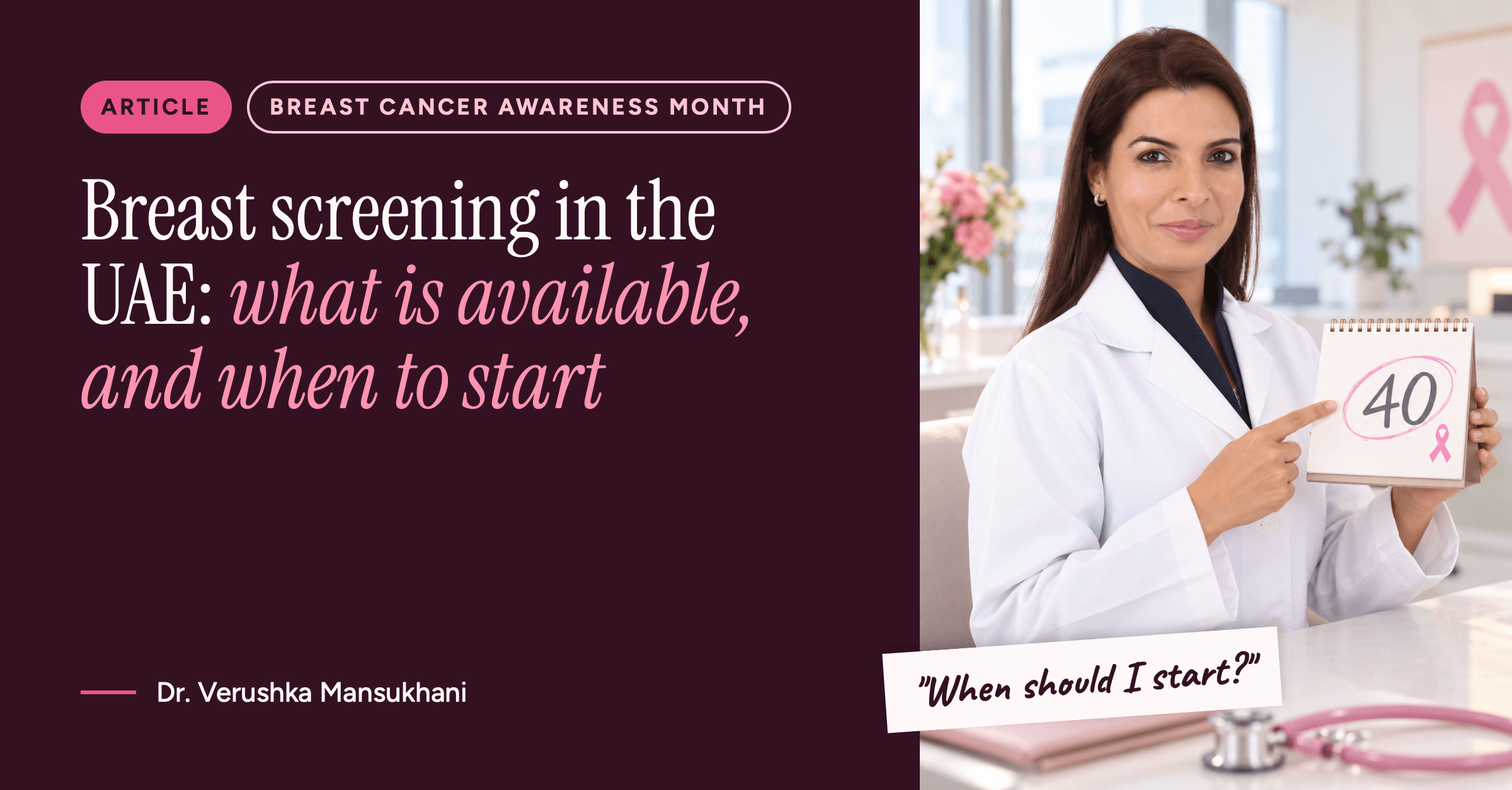
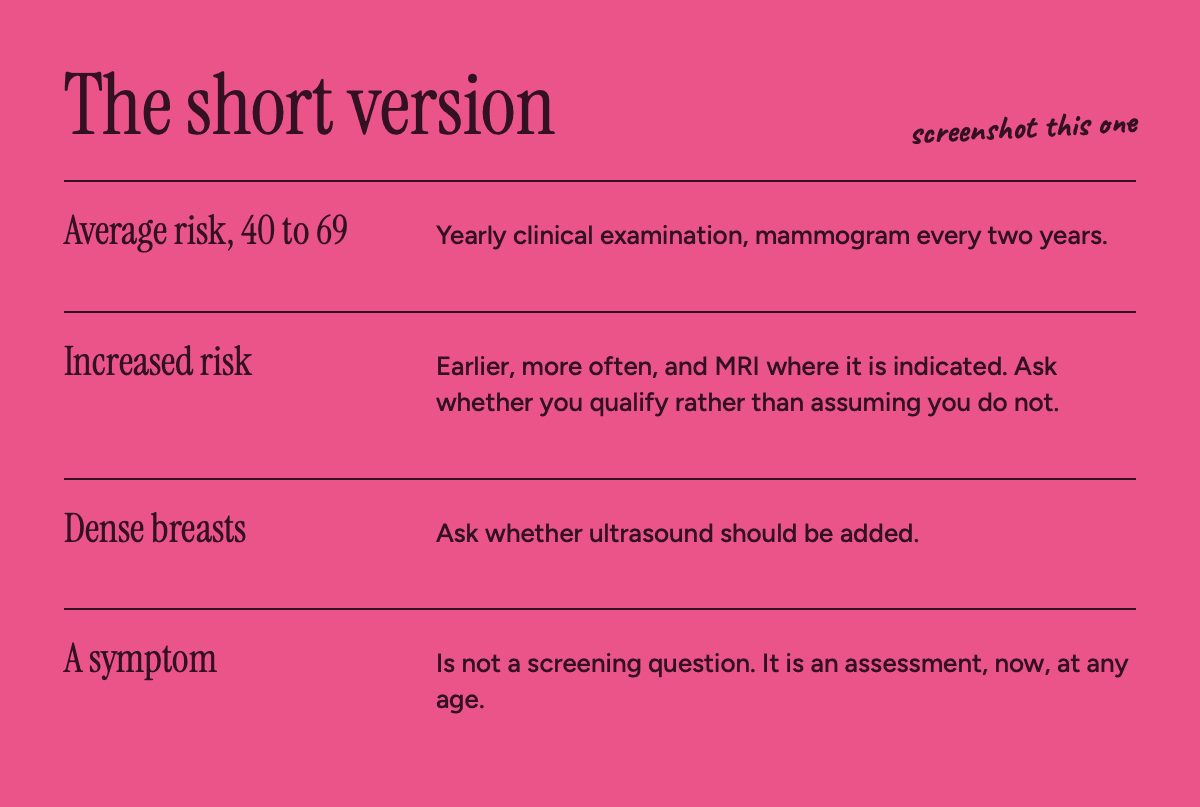
Under the UAE national guidelines, women at average risk aged 40 to 69 are advised to have a clinical breast examination each year and a mammogram every two years. Women at increased risk start earlier, are screened annually, and may be offered MRI. A symptom at any age is an assessment, not a screening question.
In short
- UAE national guidelines advise women at average risk aged 40 to 69 to have a clinical breast examination yearly and a mammogram every two years.
- Women at increased risk are screened earlier and annually, with MRI where it is indicated, and the starting age is individualised rather than fixed.
- Screening mammography is not recommended below age 40 at average risk, and not before age 30 in any ordinary circumstance.
- Every screening mammogram in the UAE must be read independently by two radiologists, with a third brought in if they disagree.
- A screening recall does not mean cancer has been found. The great majority of women recalled do not turn out to have cancer.
- A symptom is not a screening question. A new lump at any age needs assessment now, not at a future screening age.
Screening and diagnosis are not the same test
Most of the screening advice circulating online was written for the United States or the United Kingdom. It is not wrong, but it is not ours. The UAE has published its own National Guidelines for Breast Cancer Screening and Diagnosis, and they apply to every licensed healthcare provider in the country.
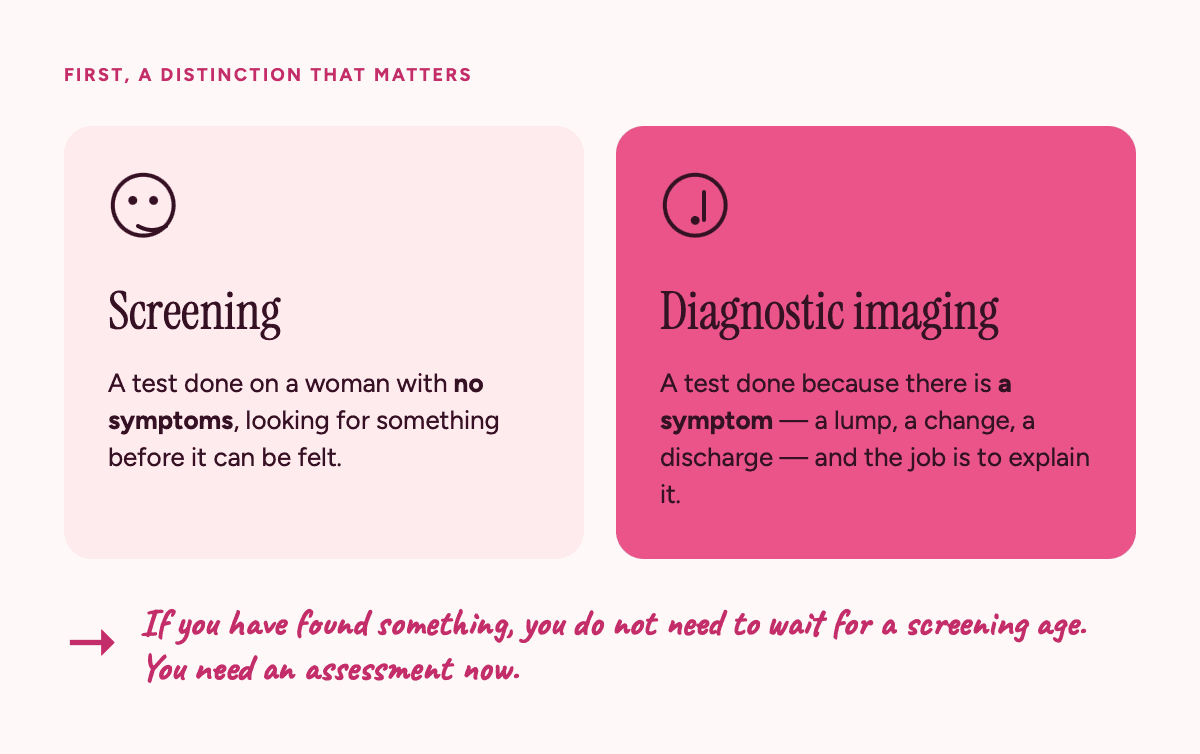
Screening is a test done on a woman with no symptoms, looking for something before it can be felt. Diagnostic imaging is a test done because there is a symptom, a lump, a change, a discharge, and the job is to explain it.
They are different tests with different rules, and conflating them causes real confusion. If you have found something, you do not need to wait for a screening age. You need an assessment now.
If you are at average risk
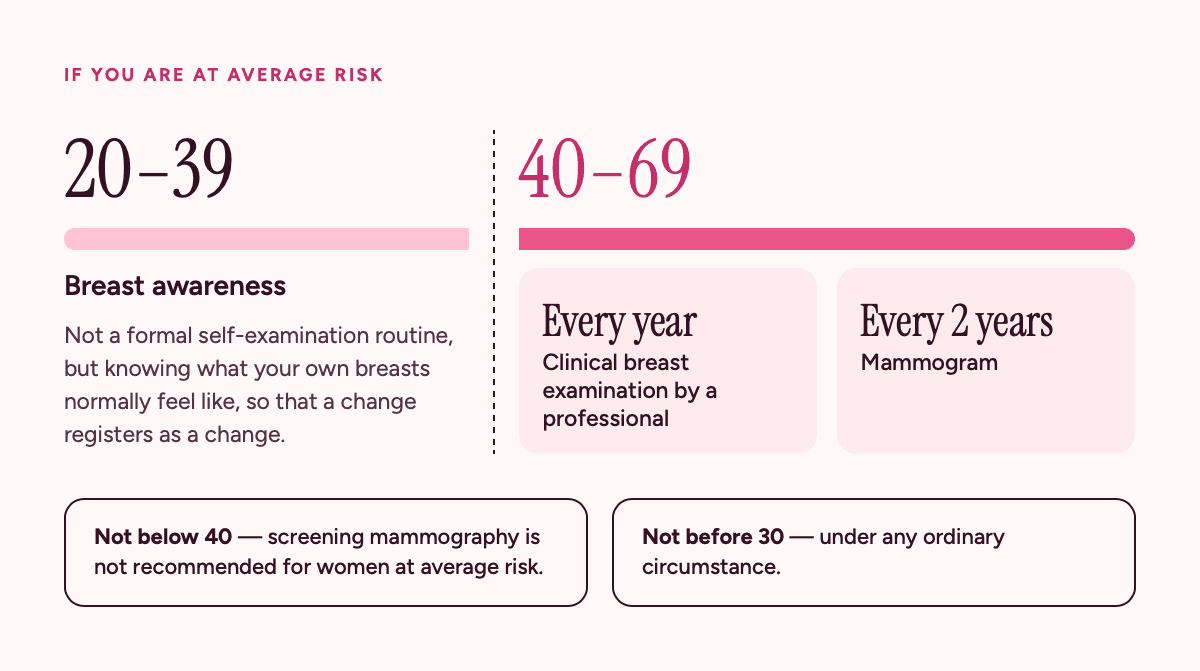
20 to 39: breast awareness. Not a formal self-examination routine, but knowing what your own breasts normally feel like, so that a change registers as a change.
40 to 69: a clinical breast examination by a professional every year, and a mammogram every two years.
The national guideline also states that screening mammography is not recommended below the age of 40 for women at average risk, and not before 30 under any ordinary circumstance.
If you are at increased risk, the schedule changes
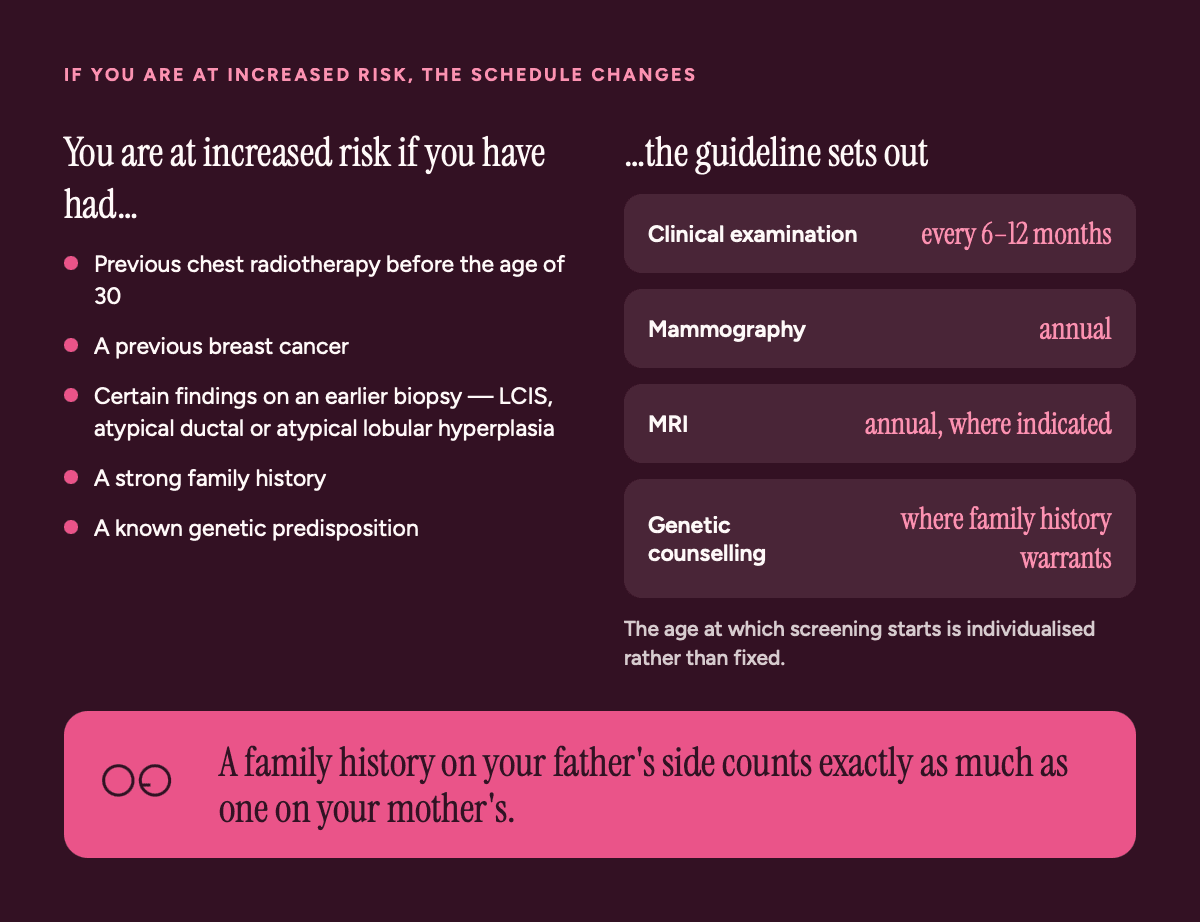
You are considered at increased risk if you have had previous chest radiotherapy before the age of 30, a previous breast cancer, certain findings on an earlier biopsy, lobular carcinoma in situ, atypical ductal hyperplasia or atypical lobular hyperplasia, or a strong family history or known genetic predisposition.
In that case the guideline sets out a clinical examination every six to twelve months, annual rather than two-yearly mammography, annual MRI where indicated, and referral for genetic counselling where the family history warrants it. The age at which screening starts is individualised rather than fixed.
MRI is specifically indicated for women carrying a BRCA1 or BRCA2 mutation, those with a first-degree relative carrying one, those who received chest radiation between the ages of 10 and 30, and carriers of TP53 or PTEN mutations.
A family history on your father's side counts exactly as much as one on your mother's. The guideline is explicit that both sides of the family are considered independently.
Why younger women often have an ultrasound instead
Younger breast tissue is denser. On a mammogram, dense tissue and a lesion can both appear white, which makes a mammogram harder to read in exactly the group where you would most want clarity.
Ultrasound handles dense tissue better, which is why it is often the first test under 40, and why the guideline recommends it as an addition to mammography for women with dense breasts at any age.
This is not ultrasound replacing mammography. For women over 40 the mammogram remains the screening test; ultrasound is added to it.
Three things about the UAE system that surprise people
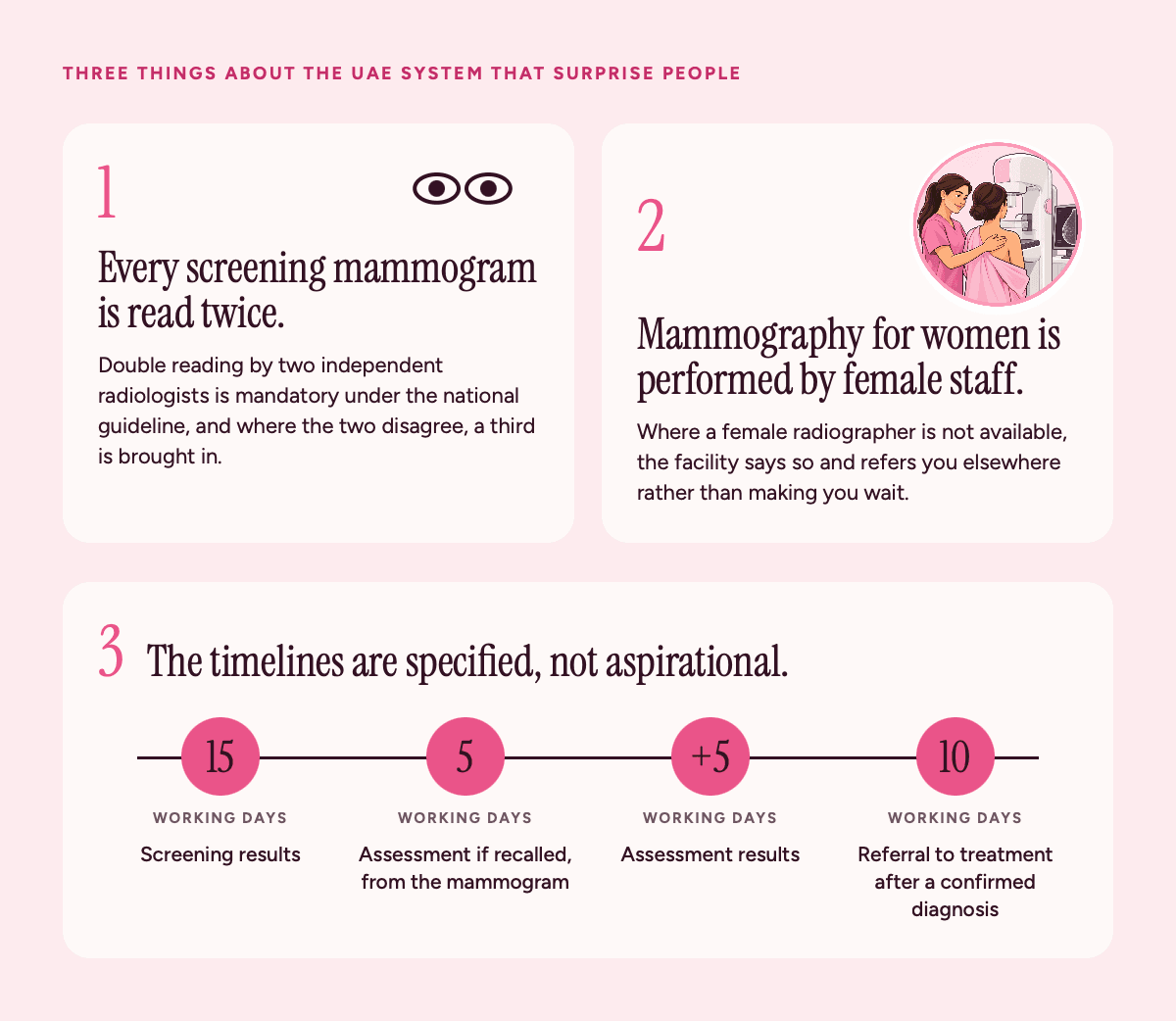
Every screening mammogram is read twice. Double reading by two independent radiologists is mandatory under the national guideline, and where the two disagree, a third is brought in. Most women have no idea this happens.
Mammography for women is performed by female staff. The guideline requires it, and requires that where a female radiographer is not available, the facility says so and refers you elsewhere rather than making you wait.
The timelines are specified, not aspirational. Results within fifteen working days. If you are recalled, assessment within five working days of the mammogram. Assessment results within a further five. Referral to treatment within ten working days of a confirmed diagnosis.
Being recalled is not the same as being diagnosed
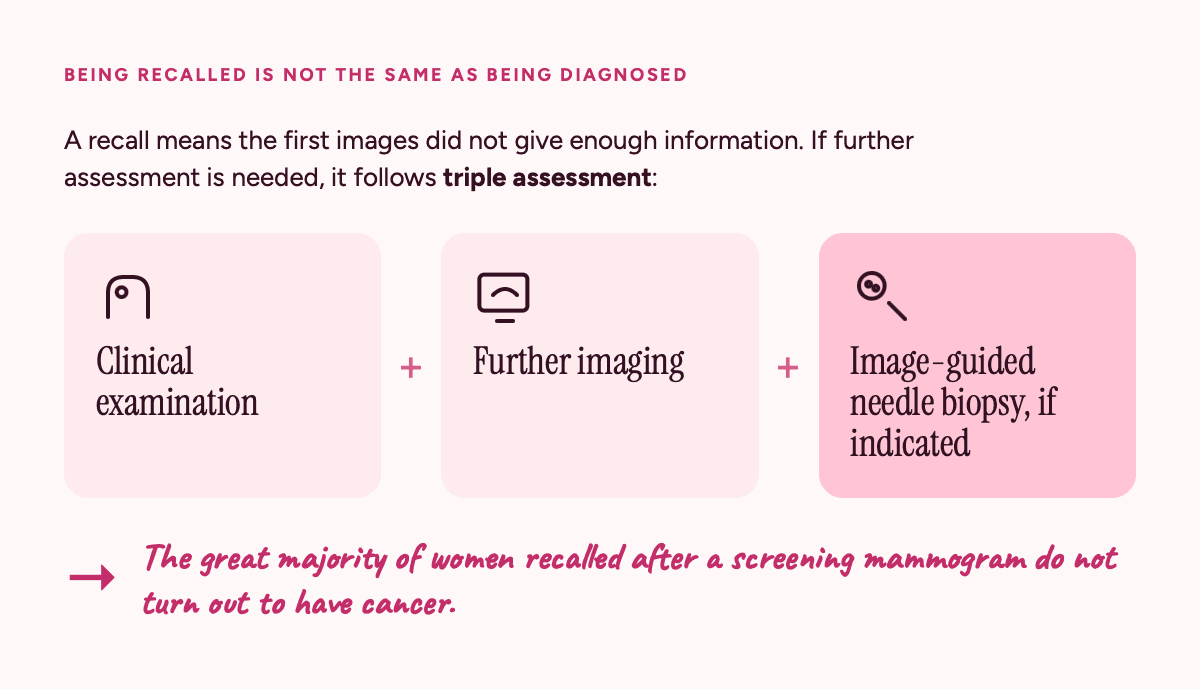
A recall means the first images did not give enough information, overlapping tissue, an unclear area, or no previous mammogram to compare against. The great majority of women recalled after a screening mammogram do not turn out to have cancer.
If further assessment is needed, it follows triple assessment: clinical examination, further imaging, and an image-guided needle biopsy if indicated. A small clip is placed at the biopsy site so the exact area can be identified on future imaging.
The guideline is firm that cytology alone must never be used to diagnose a breast cancer, and that the results are reviewed by a multidisciplinary team rather than by one person.
What screening does, and what it does not do
Screening finds cancers earlier, when there are more options and less treatment is needed. That is the case for it, and it is a strong one.
It is also not perfect, and you should know that before you go. A mammogram can miss a cancer, particularly in dense tissue. It can find something that would never have caused harm in your lifetime, and you may then be treated for it. It can recall you for something that turns out to be nothing, after a fortnight of worrying.
The national guideline requires that you are given written and verbal information about benefits, risks and limitations before the test. If you are not offered that, ask for it.
Screening is a reasonable thing to do. It is not a guarantee, and nobody should offer it to you as one.
During October specifically
Several UAE initiatives offer free clinical breast examinations and mammograms during Breast Cancer Awareness Month, including mobile units that travel between the emirates.
If cost or access has been the obstacle, this is the month in which it is most likely to be removed.
Common questions
At what age should I start having mammograms in the UAE?
Under the UAE national guidelines, women at average risk begin mammographic screening at 40 and continue to 69, having one every two years alongside a yearly clinical breast examination. If you are at increased risk, screening starts earlier and is annual, and the starting age is decided individually.
How often should I have a mammogram?
Every two years for women at average risk aged 40 to 69. Annually for women at increased risk. Your own treating team may advise differently based on your history, and that advice takes precedence over a general guideline.
I am under 40 and have found a lump. Do I have to wait?
No. A symptom is not a screening question. A new lump needs assessment at any age, usually beginning with ultrasound rather than mammography in younger women.
I was recalled after my mammogram. Does that mean I have cancer?
Almost certainly not. A recall means the images did not give enough information and further views or an ultrasound are needed. The great majority of women recalled after a screening mammogram do not have cancer.
I have dense breasts. Is a mammogram still useful?
Yes, but ask whether ultrasound should be added. Dense tissue makes a mammogram harder to read, and the UAE guideline recommends ultrasound as an adjunct for women with dense breasts.
Will a man perform my mammogram?
The UAE national guideline requires that mammography for women is performed by female radiographers, and that where one is not available the facility tells you and refers you elsewhere rather than delaying you.
Sources and further reading
- Ministry of Health and Prevention, UAE, National Guidelines for Breast Cancer Screening and Diagnosis
- NHS, Breast screening (mammogram)
- Cancer Research UK, Breast cancer
External guidance is written for other health systems. Where it differs from advice given to you in Dubai, the advice from your own treating team applies.
Still not sure whether it needs looking at?
Most breast changes turn out to be benign. Working out which ones are is what an assessment is for, and the guides here explain what that involves before you go.